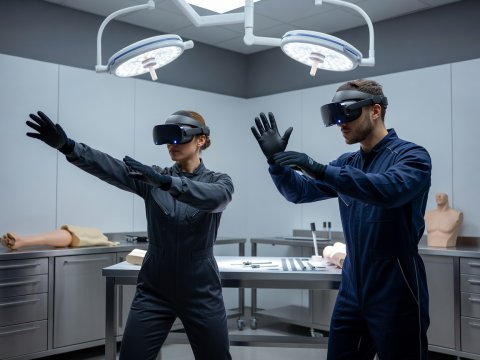
Clinical & Control-Room Ergonomics
Hospital design teams walk nurses and anaesthetists through life-size operating theatre mockups to verify monitor visibility and boom-arm clearance long before wall framing begins.
When you look at a photograph of a mountain pass, you read depth intellectually. When you step into a well-calibrated virtual landscape, your neck, inner ear, and visual cortex negotiate scale automatically.

In 1968, computer scientist Ivan Sutherland demonstrated a ceiling-suspended optical headset at Harvard and the University of Utah—nicknamed the Sword of Damocles—that rendered a glowing wireframe cube floating inside a physical laboratory. The cube possessed neither texture nor shadow, yet observers immediately treated it as occupying a fixed point in the room. Why? Because whenever they leaned left or stepped closer, the cube's lines recalculated to match human head motion.
Decades later, Jaron Lanier popularised the phrase "virtual reality" in the late 1980s at VPL Research, while Carolina Cruz-Neira, Thomas DeFanti, and Dan Sandin unveiled the CAVE Automatic Virtual Environment in 1992—a surround-projection room where small teams could inspect geological strata or molecular assemblies together without heavy headgear. Across every hardware form factor, one lesson held firm: immersion is driven less by decorative detail and far more by sensorimotor contingencies—the tight agreement between how your body moves and how the world answers.
Cognitive scientist Mel Slater's research at University College London and the University of Barcelona separated virtual experience into Place Illusion (being there) and Plausibility Illusion (events feeling genuine). Modern creators build those two sensations out of concrete engineering choices:
Viewing an environment on a flat monitor flattens human scale: a four-metre ceiling and a six-metre ceiling look remarkably similar in a wide-angle architectural render. Stepping inside at 1:1 eye height reveals cramped sightlines or intimidating overhangs within seconds.
Hospital design teams walk nurses and anaesthetists through life-size operating theatre mockups to verify monitor visibility and boom-arm clearance long before wall framing begins.

Sites such as the Chauvet Cave in southern France restrict human breath and moisture to protect paleolithic pigments. Millimetre photogrammetry allows scholars and museum visitors to stand beside cave alcoves safely.

Mission scientists assemble stereo rover imagery into walkable terrain patches so geologists can crouch beside rock strata and judge slope angles intuitively when planning sample routes.
Even the sharpest virtual landscape collapses if artificial camera glides conflict with a stationary body—a mismatch known as vection-induced discomfort. Experienced spatial studios anchor users with stable horizon references, tactile rest frames, deliberate teleportation arcs, or physical room-scale walking zones. They also treat lighting softly: harsh specular flicker fatigues stereo vision, whereas warm bounced illumination helps eyes fuse depth effortlessly over thirty-minute review sessions.
Cookies on this site Essential cookies keep this site working. Optional ones help us see what is useful. You can change your choice at any time. More about cookies